The Races Menu in RUFUS Race Manager (RRM) is where you view and manage all races defined for an event. From here, you can open race dashboards, edit race settings, and create new races.
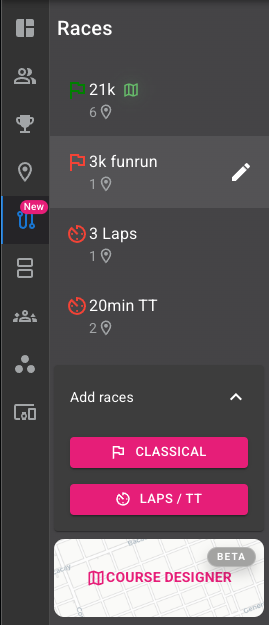
Viewing Defined Races
- All races already created for the event are listed in this menu.
- Each race is shown by name, making it easy to identify.
- Next to the race name, you can also see the number of checkpoints associated with that race.
Opening a Race
Clicking on a race name opens the Race Dashboard, where you can find detailed information and tools to manage that race.
Editing a Race
Hover over a race name and click the pen icon to open the Edit Race modal, where you can adjust race details such as name, distance, and other configurations.
Creating a New Race
At the bottom of the Races Menu, you’ll find the Add races section.
- Classical (V2) → Create a traditional mass-start race. This is the standard format for most running, cycling, and triathlon events.
- Laps/Time-Trial → Create lap based races. This is the standard format for most motor sports events.
Creating a Race Course
Operators can design a race course directly on an interactive map with the Course Designer, either by drawing it manually or importing it from GPX/KML. Event checkpoints can be placed as shared physical locations and reused across multiple races, making setup cleaner and faster.