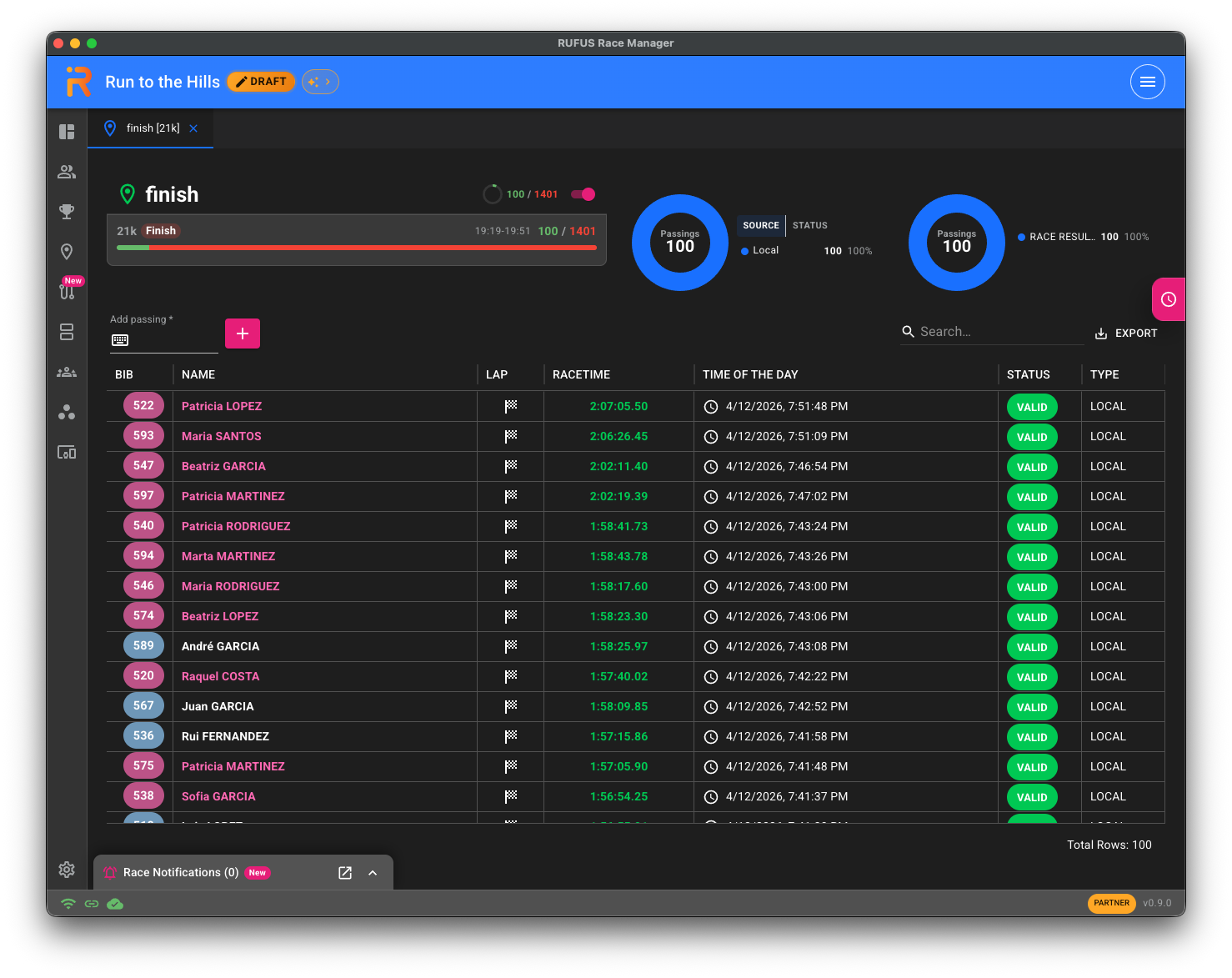
The Checkpoint-Race View in RUFUS Race Manager (RRM) provides detailed visibility into all passings captured for a specific checkpoint and race. It is designed to help race organizers monitor activity at that checkpoint in real time, ensuring accuracy and control during the event.
Overview
- The grid displays all assigned passings for the selected checkpoint and race.
- ORPHAN passings do not appear in this view because they are not linked to a participant or race.
- This view does not show rankings or classifications. It is purely a passing-level view, focused on what was captured at the checkpoint.

The grid includes key information for each passing:
- BIB → Participant’s bib number
- Name, Gender, Age Group → Participant details
- Chip → The chip ID used in timing
- Lap → The lap number associated with the passing
- Racetime → Time elapsed since race start
- Time of the Day → Exact clock timestamp
- Status → Passing status (VALID, BOUNCED, etc.)
- Type → Origin of the passing (e.g., AUTOMATIC, MANUAL, BACKUP FILE)
- Device → The device that captured or created the passing
As with other grids in RRM, you can filter, sort, group, and search the data to find exactly what you need.
Adding Manual Passings
You can add passings directly from the Checkpoint-Race View by entering the participant’s BIB number.
- The timestamp recorded will be the exact moment the passing is entered.
- The passing is then processed by the system using the full validation logic, ensuring it receives the appropriate status.
- This feature is particularly useful when a participant is observed crossing but their chip was not detected.
For broader corrections, consider using Floating Passings, which are not tied to a specific checkpoint but use the entire race plan to infer the correct placement. See Floating Passings.
Viewing Race Time
At the top of the Checkpoint-Race View, the current race time is displayed. This acts as a reference clock for the ongoing race and helps contextualize the passings you are reviewing.
When to Use the Checkpoint-Race View
- During the race → Monitor live passings at a critical checkpoint.
- After the race → Review checkpoint activity for accuracy, identify missed or duplicated passings, and correct them with manual or floating entries.
- Operational monitoring → Focus on a specific race and checkpoint without being distracted by global event data.
Summary
The Checkpoint-Race View is an essential operational tool in RRM. It provides:
- Detailed grids of all checkpoint passings for a race
- Manual addition of missing passings
- Real-time race time display
- Full grid management (filtering, sorting, grouping)
By using this view effectively, race organizers can maintain precise oversight of critical checkpoints and ensure reliable timing data throughout the event.